Law schools

 SITE SEARCH


 » Law schools  » Law career  » Law degrees  » Bachelor of laws

Bachelor of laws


Bachelor of laws

The degree of Bachelor of Laws is the most important academic degree in law in most common law countries. It is abbreviated LL.B. (or LLB) - LL. is abbreviation for the plural legum (of laws); thus LL.B. stands for Legum Baccalaureus in Latin. In the United States it is sometimes erroneously called "Bachelor of Legal Letters" to account for the double L.

In the United States the LL.B. became a three year graduate degree taken after completion of a four-year undergraduate degree. In the United States the LL.B. has been substituted by the Juris Doctor (J.D.) degree, although the form and structure of the degree is little changed. Foreign law graduates must often study to receive an LL.M., the masters’ degree equivalent, before qualifying for bar admission procedures.

Structure of LL.B. programmes
Nowadays, few institutions, such as Cardiff University's Department of Canon Law and McGill University's and the University of Ottawa's shared programme, continue to offer options to the common law. In the past, law students studied both civil law and common law. Nowadays, this is less common.

Common law countries generally
In many common law countries, the Bachelor of Laws programme is generally entered immediately after conclusion of secondary school, with the exception of Canada and the U.S., but some universities in Britain and Australia also offer the programme as a shorter duration, second-entry programme for the LL.B. following completion of a previous undergraduate degree.

Canada
Canada has a dual system of laws. At the federal level, as well as in every province or territory a system of common law is used; except Quebec, a system of civil law is used. Because of this, there are two Canadian law degrees available.

The programme of study for the common law LL.B. is usually a second-entry degree programme. While the degree conferred is at the first-degree level and admission may be granted to candidates with two or three years of undergraduate studies towards a degree, in practice the programme usually needs completion of a previous undergraduate degree before registration in that programme. In fact, almost all admitted law students hold at least a bachelor level degree, and a significant number hold a graduate level degree as well.

Canadian law schools generally require three years of full-time study to earn the Bachelor of Laws (LLB) or JD degree, but cannot practice law yet. In order to practice law, the graduate must then be licensed by the Law Society of the province where he/she wishes to practice law. Those law graduates wishing to become law professors instead of lawyers would have to gain a more advanced law degree such as the Master of Laws (LL.M.) or the Doctor of Laws (LL.D., S.J.D. or D.Jur.) at a law school offering programmes principal to such degrees. Many schools have developed limited part-time programs for the study of law. Most law schools share a common approach to training lawyers. However, they differ in the emphasis they give to certain subjects and teaching methods, such as opportunities for independent study, clinical practice, legal internships, and involvement with governmental affairs. Many of Canada’s law schools with common law programs offer joint degrees that combine common law with other disciplines, such as business.

In Canada, the civil law programme is three years in length. The programme of study for the first degree in Quebec civil law (called LL.B., B.C.L. or LL.L.) is a first-entry degree programme. Like other first-entry university programmes in Quebec it requires a CEGEP diploma for entry. Law schools that offer civil law B.C.L. or LL.L. Degrees include McGill University and the University of Ottawa. Some law schools offer joint or dual degrees of common law and civil law, because of Canada's dual system of laws. McGill University and the University of Ottawa are two law schools which offer such degrees.

A number of Canadian law schools offer students the opportunity to earn, besides their three-year first degrees in common law, programmes in common law for holders of baccalaureate degrees in Quebec civil law enabling those individuals to earn the LL.B. in common law in two or three semesters, depending on the offering university's program.

Becoming a lawyer
The graduates of the LL.B. degree or its equivalent are usually qualified to apply for membership of the bar or law society. The membership eligibility conferred may be subject to completion of professional exams. A student may have to profit a further qualification at postgraduate level, for example the Legal Practice Course or Bar Vocational Course in England and Wales or the PCLL in Hong Kong.

In Australia, LL.B. graduates are required to undertake a one year articled clerkship or the Legal Practice Course (generally Practical Legal Training or PLT) before applying for registration as a solicitor. Membership of the Bar is restricted to Barristers, and is obtained through the successful completion of an examination and a nine-month period of tutelage (the reading period) under a senior Barrister.

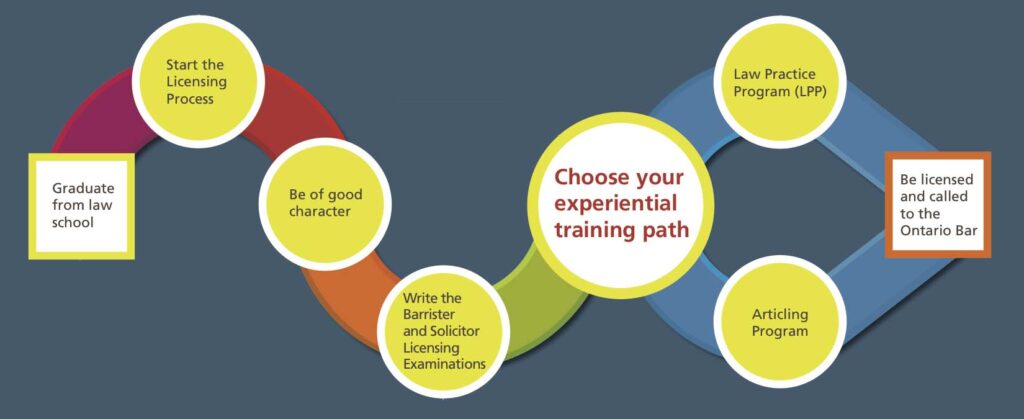
In Canada, the lawyer licensing process generally requires the law graduate to 1.) Take further classroom law courses, taught by the law society itself, and pass a set of written examinations, normally referred to as bar exams, related to the taken courses and 2.) Complete articled clerkship commonly known as articling. In either articling or clerkship, there is the expectation that the law graduate will work in a diversity of legal fields and be exposed to the harsh realities of legal practice that are absent from law school's academic atmosphere.

For example, in the Province of Ontario, the licensing process for the Law Society of Upper Canada (Ontario's governing law society) consists of three mandatory components: The Skills and Professional Responsibility Program with assignments and assessments, Licensing Examinations (a Barrister Licensing Examination and a Solicitor Licensing Exam), and a 10-month Articling term.

At the conclusion of the licensing process, the law graduate is "called to the bar" whereby he/she signs his/her name in the rolls of solicitors and swears lawyer-related oaths in a formal ceremony where he/she must appear in a complete barrister's robe and bow before judges of the local superior court and benchers of the licensing law society. After the call ceremony, he/she can designate him/herself as a "solicitor and barrister", and can practice law in the province in which he/she is licensed. In the Province of British Columbia, licensed lawyers are automatically permitted to practice the powers of a Notary Public. In Ontario and other provinces, a licensed lawyer requires further licensing from another authority, such as the provincial lawyer general, before he/she can work in a Notary Public capacity.


Alternative titles and formats

Juris Doctor (J.D.)
In the United States, the LL.B. became the Juris Doctor (J.D.) degree, a three year graduate degree usually taken after conclusion of a four-year undergraduate degree.

In universities from other common law jurisdictions generally still award the LL.B. degree as the basic professional law degree, some law schools in Canada, Hong Kong, and Australia have changed their LL.B. programmes to Juris Doctor Programmes.

Irish B.C.L.
While a number of universities in Ireland award the LL.B. as the basic professional degree in law, some universities in that country award the degree of Bachelor of Civil Law (B.C.L.). It should be noted, though, that Ireland is a common law jurisdiction and the expression "civil law" is used to differentiate common law from ecclesiastical law in the republic.

Zimbabwe B.L. and LL.B.
The first degree in common law is the Bachelor of Law (B.L.), at the University of Zimbabwe, which is equivalent to the LL.B. in other common law jurisdictions. It is followed by a one year programme at the university (analogous to post-LL.B. vocational programmes in other common law jurisdictions) at the end of which a second degree, the Bachelor of Laws (LL.B.), is awarded.

The LL.B. in Pakistan
In Pakistan, a person going for a LL.B. degree should have a bachelor's degree. Most law students choose to obtain a two year bachelor degree before registering for a LL.B. degree in a law college. The LL.B. itself is a three year programme. In Punjab, a five year joint B.A./LL.B. degree is being offered by law colleges.
After obtaining a LL.B. degree, a person wishing to practise has to intimate the concerned Bar Council that he is undergoing a six month training period under the supervision of a High Court lawyer with ten year standing. After he completes the pupillage, he will be asked to take a written test and undergo a viva-voce exam.

Variations on the LL.B.
Various universities in the United Kingdom and New Zealand offer variations of this degree, such as the LL.B. (Europe), which generally take four years to complete and include a wider range of topics as well as some degree of specialisation.

Some universities in the United Kingdom and Australia will permit a degree that combines study with a non-law discipline.

The University of London External Programme in Laws (LL.B.) has been awarding its law degree via distance learning since 1858. The LL.B. awarded by the University of London External Programme is of the same standard and quality irrespective of the mode or manner of learning.

At various universitied in the UK such as Oxford, and Cambridge the principal law degree is a B.A., in either Jurisprudence or Law respectively; the B.C.L. and LL.B. (recently renamed LL.M.) are postgraduate degrees.

Eligibility to Practise Law in the U.S. with Foreign Credentials
Foreign law graduates seeking admission to the bar in the United States may find their LL.B. law degree fulfills core admission conditions and permits them to take the bar exam. The procedures vary between states and interested applicants should seek specific advice. For example, New York permits holders of University of Oxford and Cambridge University B.A. in Laws and University of London LL.B. (excluding degrees gained through the External Programme) to take the bar, and both New York and Massachusetts permit Canadian LL.B. holders to take the bar. (The University of Toronto J.D. is a renamed LL.B. and treated no differently by American states.)

Situation within the European Union
The actual procedure to receive the respective national licence is regulated by the member state and therefore differs from country to country, but every EU member has to apply the relevant EU Directives to its own national law.
European Union law allows European Union citizens with LL.B. degrees from Ireland or the UK, who practise law in one of these countries for three or more years, to practise also in every other member state.

Recently various universities in Germany have introduced LL.B. degrees as part of the Bologna process. The LL.B. is a cornerstone to the future of law practice in Germany. The LL.B. is a three or four year basic law degree. Some students follow the LL.M. after pursuing the LL.B. The LL.B. in Germany covers all classes which are also required for the First State Exam. A credit point system is used for the LL.B. degree. In order to get the LL.B. students have to pass more exams and thus collect more points than needed for the First State Exam. By obtaining the LL.B., a student is automatically qualified to sit for the First State Exam. It is expected that the First State Exam will be completely replaced by the LL.B. by 2010.

In Malta, the University of Malta offered, the Bachelor of Laws (LL.B.) degree is an undergraduate degree that of itself is not sufficient for admission into any of the legal professions.

Alternative to a law degree in England/Alternative degree route in Scotland
There are also change courses available for non-law graduates, available as an option to the full-length LL.B. degree course. One such example of a change course in England and Wales is the GDL (Graduate Diploma in Law), which takes one year to complete.

The most important Scottish approach to this is the so-called 'second-entry' (undergraduate) LL.B. degree, where graduates from another discipline can complete the LL.B. in two years, although this may occasionally require taking qualifying law courses within the first degree to meet professional requirements in full. Therefore it is not totally correct to regard it as an 'accelerated' degree.

This 'double degree' system was, at one time, an option route to the former B.L. degree (now obsolete) but students were required to have independent facilities to complete the second degree. The current Scots LL.B. degree, a direct-entry undergraduate degree, meets all professional requirements when coupled with the Diploma in Legal Practice. The Diploma was introduced approximately in 1980; prior to this, all professional exams were taken within the degree itself (or as part of an earlier non-law degree), limiting the range for academic study.


Back to:
:. Law degrees
:. Law career
:. Law Schools
Sponsored by:
:. Language courses
:. Resume Templates


About us  |  Contact us  |  Advertising  |  How to link to us  |  Partners  |  Sitemap

© Law schools 2005 - 2008

Language schools  |  Translation schools  |  Business schools  |  Law schools  |  Medical schools  |  Nursing schools  |  Dental schools
Pharmacy schools  |  Real Estate schools  |  Technical schools  |  Music schools  |  Film schools  |  Dance schools  |  Art schools
Military schools  |  Boarding schools  |  Driving schools  |  Golf schools  |  Sailing schools  |  Ski schools  |  Cooking schools