Law schools

 SITE SEARCH


 » Law schools  » Law career  » Being a lawyer

Being a lawyer


Being a lawyer

Law practice is so varied that it is not possible to describe the so-called typical lawyer. The work of a lawyer is interesting, challenging and rewarding. Each lawyer works with distinct clients and distinct legal inconvenience. Lawyers give legal advice on a wide diversity of issues, and a career in the legal profession offers tremendous range and prospects for young people. Generally, certain basic legal abilities are required of all lawyers. They must know:

  • how to analyze legal issues in light of the existing state of the law, the road in which the law is headed, and important policy considerations;
  • how to synthesize material in light of the fact that many issues are multifaceted and need the combination of different elements into a coherent whole;
  • how to advocate the views of groups and individuals within the context of the legal system;
  • how to give intelligent advice on the law’s requests;
  • how to write and speak clearly; and
  • how to negotiate effectively.

Reading and Listening
Lawyers must be able to take in a great deal of information, often on subjects about which they are unfamiliar. The skill to assimilate information from lengthy, dense texts is necessary. Equally important is the skill to listen to clients and understand their unique issues and concerns.

Analyzing
Lawyers must be able to resolve the fundamental elements of problems. They spend much time discerning the nature and significance of the many issues in a particular problem and arrive at an answer, result, or solution.

Synthesizing
Lawyers must learn that because of the difficulties of many issues and the number of laws, they must be able to pull together in a significant, focused, cogent manner often large quantities of information.

Advocating
As an advocate, the lawyer’s function is to represent his or her client’s particular point of view and interests as energetically as possible. Lawyers must be able to use their advocacy abilities to marshal evidence and present arguments as to why a particular outcome is desirable. The American judicial system assumes that reasonable solutions will emerge from the clash of opposing interests.

Counseling
Lawyers spend great part of their time giving clients legal counsel. Few transactions in the modern world can be undertaken without some understanding of the law. Through their knowledge of what the law includes, lawyers counsel clients about partnerships, decisions, actions, and many other subjects.

Writing and Speaking
The law is personified in words, and many of the arguments that give origin to laws begin with language—its meaning, use, and interpretation. Litigation leads to written judicial opinions; congressional promulgations are recorded as printed statutes; and even economic transactions must be expressed as formal, written contracts.
Whether in the courtroom or the law office, lawyers must be efficient communicators. If lawyers could not explain thoughts and opinions into clear and accurate English, it would be difficult for the law to serve society.

Negotiating
Reconciling different interests and opinions is one of the lawyer’s primary roles. When the parties to a proposed transaction disagree, the lawyer, acting as a facilitator, may be able to help them transact to a common ground. Although the client’s interests are a lawyer’s first priority, often those interests are served best after compromise and conciliation have paved the way to an equitable settlement.

Qualifying as a Lawyer
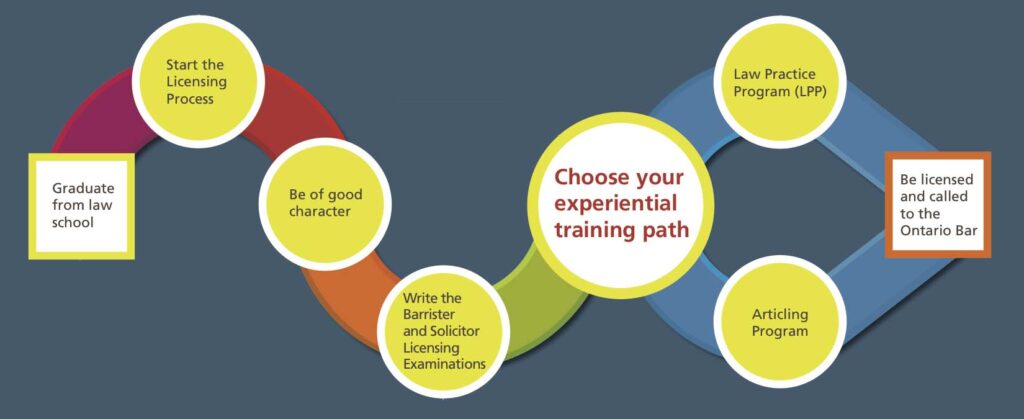
To become a solicitor or barrister are needed top grades during your academic studies. The fastest route into the profession is to get top marks in GCSEs and A-levels, at least a 2.1 university law degree, and then further training and qualifications.

The further training depends on whether you wish to become a barrister or solicitor. For barristers, the one-year Bar Vocational Course (BVC) followed by at least 12-month pupils in chambers is obligatory. Pupils are divided into two six-month periods, usually referred to as 'sixes'. Solicitors take the one-year Legal Practice Course (LPC) followed by a two-year training contract, generally with a firm of solicitors, or the legal section of a commercial firm or government department.
Throughout the country, the colleges and universities are offered the LPC and BVC, and guarantee that students have the necessary abilities to work in a solicitors' office or barristers' chambers.

Taking the Common Professional Exam or Graduate Diploma in Law the Graduates in a non-law degree subject can still qualify as a solicitor or barrister, before embarking on the LPC/BVC, although this entails an extra year's study and more expense. These 'conversion courses' prepare non-law graduates for a legal career as they cover the foundations of law, namely contract, tort, criminal law, equity & trusts, EU law, property law and public law.

Timetable
The law is a career that enrolls years in advance (many employers recruit during the penultimate year of the law degree), which means it's never too soon for students to plan their path from school to university to solicitors’ office or barristers' chambers.

At school and college
Aspiring lawyers should focus on getting top grades; most university law courses need GCSEs at A and B grades and a minimum of 3 good A-levels (note that some firms and chambers won't accept an A-level in general studies).

Also, they should seek out informal work experience opportunities, firstly through their sixth form or college. If school/college doesn't offer placements, it's time to 'network' - that is, use existing contacts such as family or friends and earn experience.

At university
Lawyer’s students set on a career in law need to continue getting good grades in their university life, and not make the error of thinking that it’s only the end-of-third-year exam performance that counts. First and second-year exam results are taken into account by firms and chambers when considering applicants for work experience, as well as training contracts/pupils. Most will want to see a stable stream of 2.1s and Firsts.


Back to:
:. Law career
:. Law Schools
Sponsored by:
:. Language courses
:. Resume Templates


About us  |  Contact us  |  Advertising  |  How to link to us  |  Partners  |  Sitemap

© Law schools 2005 - 2008

Language schools  |  Translation schools  |  Business schools  |  Law schools  |  Medical schools  |  Nursing schools  |  Dental schools
Pharmacy schools  |  Real Estate schools  |  Technical schools  |  Music schools  |  Film schools  |  Dance schools  |  Art schools
Military schools  |  Boarding schools  |  Driving schools  |  Golf schools  |  Sailing schools  |  Ski schools  |  Cooking schools